Across Asia, higher education is undergoing a quiet but significant transformation. Universities are no longer designing programmes only for full time students progressing directly from school or undergraduate study. Instead, they are responding to a growing population of adult learners who are already embedded in professional life. For these learners, flexibility is not a preference but a condition for participation.
Online education has played a central role in this shift, particularly as digital infrastructure and cross border academic collaboration have expanded across the region. Yet not all online learning models function in the same way. The distinction between asynchronous education Asia and fixed schedule online classes has become increasingly important for working professionals trying to balance study with demanding careers.
This distinction matters because the structure of a programme directly affects learning quality, persistence, and professional wellbeing. Understanding how these models operate in practice helps learners make informed decisions and helps institutions design programmes that genuinely serve their audiences. This article explores both approaches in depth, focusing on their relevance to online classes Asia and their real world impact on working professionals online education Asia.
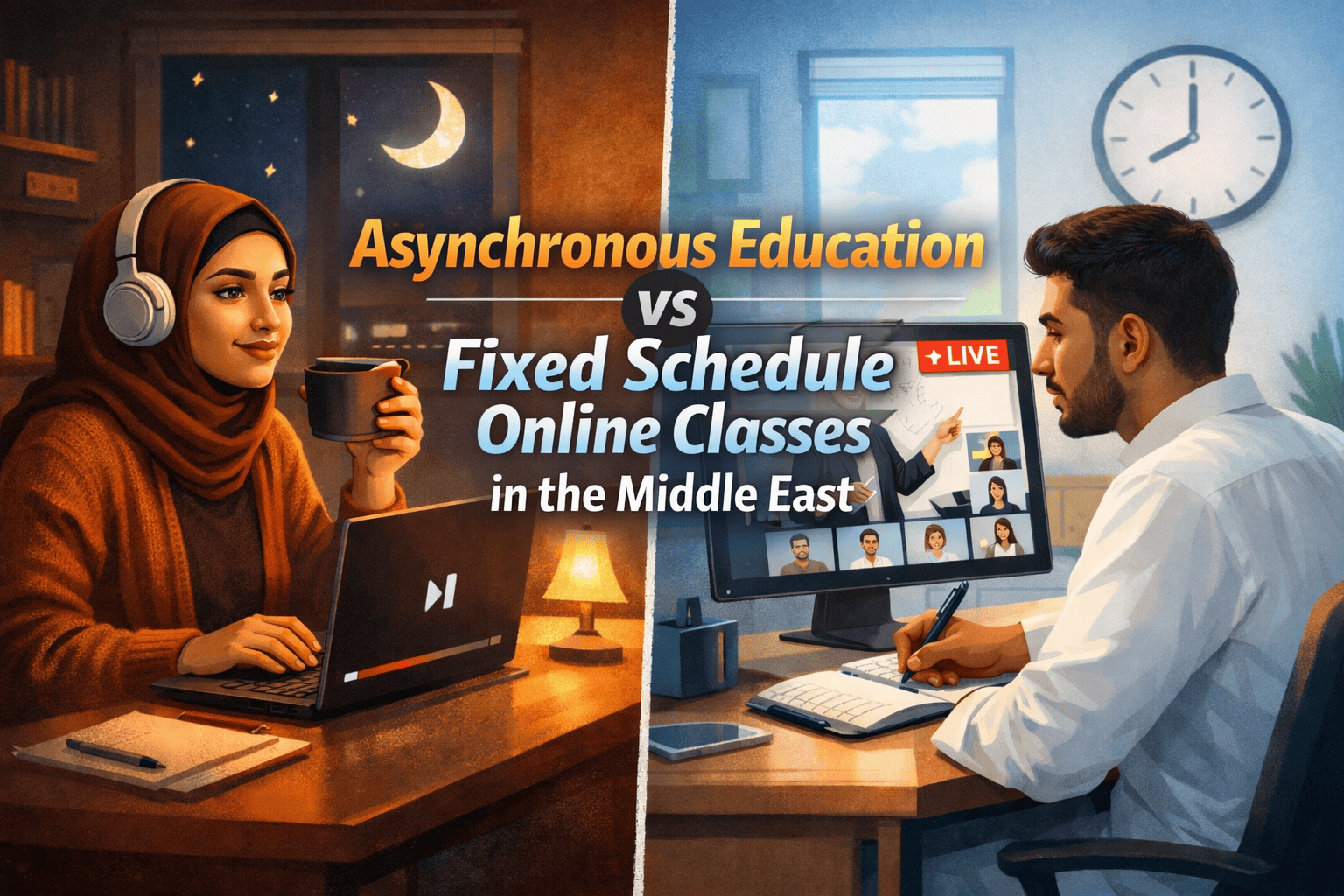
At its core, asynchronous education is defined by flexibility of time. Learners are not required to log in at specific hours for live lectures or discussions. Instead, they access learning materials such as recorded lectures, readings, case studies, and discussion prompts at times that fit their personal and professional schedules.
Within asynchronous education Asia, this model has gained strong traction across postgraduate degrees, professional diplomas, and continuing education programmes. Its relevance is closely tied to the realities of the Asian workforce, where long working hours, shift based employment, and cross time zone collaboration are common. For many professionals, fixed weekly study times are simply unrealistic.
From an academic perspective, asynchronous education is not a diluted version of university learning. When designed properly, it is grounded in adult learning theory, which recognises that experienced professionals learn differently from traditional students. Rather than relying on real time lectures, asynchronous programmes emphasise reflective learning, applied assessments, and sustained engagement with ideas over time.
For example, learners may be asked to analyse workplace scenarios, respond to peers’ perspectives in moderated forums, or submit reflective assignments that connect theory to professional practice. These activities allow time for critical thinking and encourage learners to draw directly on their own experience. Faculty interaction occurs through structured feedback, academic facilitation, and guided discussion rather than live delivery alone.
In the context of online classes Asia, asynchronous education also supports diverse cohorts. Learners from different countries, industries, and time zones can participate equally without the pressure of synchronising schedules. This inclusivity strengthens peer learning and enriches academic dialogue, particularly in programmes designed for international professionals.
Fixed schedule online classes follow a more traditional academic model, adapted to a digital environment. Students attend live sessions at predetermined times, often weekly, using video conferencing platforms. These sessions may include lectures, discussions, group work, or presentations, and attendance is often monitored.
Within online classes Asia, fixed schedule models are commonly used in undergraduate programmes, executive education, and short term professional courses. They can be effective for learners who value routine, immediate interaction, and real time feedback from instructors and peers.
For some working professionals, especially those in structured corporate roles or organisations that support study during working hours, fixed schedules can provide a sense of discipline and community. Live discussions can foster spontaneous exchange and help learners feel connected to their cohort and faculty.
However, the challenges of this model become more pronounced when viewed through the lens of working professionals online education Asia. Many professionals face unpredictable work demands, travel obligations, or shift based schedules that make consistent live attendance difficult. Even when attendance is technically possible, mental engagement may be compromised by competing responsibilities.
Time zone differences across Asia further complicate synchronous participation, particularly in programmes with regional or global cohorts. What is a convenient evening session for one learner may be late at night or early morning for another. Over time, this misalignment can lead to fatigue, disengagement, and increased attrition.
Academically, fixed schedule classes can sometimes prioritise presence over depth. While live interaction has value, meaningful learning depends on preparation, reflection, and application, all of which require time beyond scheduled sessions. Without sufficient flexibility, these elements may be constrained rather than supported.
The choice between asynchronous education and fixed schedule online classes has direct implications for career development, learning outcomes, and personal sustainability for professionals across Asia.
For many learners, asynchronous education Asia offers a structure that aligns more realistically with professional life. The ability to study during self selected time blocks allows professionals to maintain performance at work while progressing academically. This balance is particularly important for mid career learners who cannot afford to pause or reduce employment.
Asynchronous models also support immediate application of learning. Concepts introduced in coursework can be tested in real workplace contexts and reflected upon in subsequent academic activities. This continuous feedback loop strengthens learning transfer and reinforces relevance, which is a key motivator for adult learners.
In contrast, fixed schedule online classes may suit professionals in stable roles with predictable hours, or those at earlier career stages who benefit from structured guidance. For these learners, live sessions can provide clarity and momentum. However, when professional demands intensify, fixed schedules can quickly become sources of stress rather than support.
From an institutional perspective, data from admissions and academic advising teams increasingly shows that working professionals prioritise flexibility when selecting programmes. References to self paced learning pathways, modular assessment structures, and flexible postgraduate programmes now feature prominently in programme information and admissions guidance across the region.
This trend reflects a broader recognition that working professionals online education Asia must be designed around real lives, not idealised schedules. Programmes that fail to account for this reality risk lower completion rates and diminished educational impact.
Sustainability in online education extends beyond technological delivery. It encompasses academic quality, learner wellbeing, institutional credibility, and long term professional value. When evaluating models, the question is not which approach is universally better, but which is better suited to specific learner contexts.
Asynchronous education Asia has demonstrated strong sustainability for working professionals because it respects autonomy and acknowledges complexity. By allowing learners to control the timing of engagement, it reduces unnecessary pressure while maintaining academic rigour. This autonomy fosters persistence, deeper reflection, and more meaningful integration of learning into professional practice.
Globally, universities are increasingly adopting hybrid designs that lean heavily toward asynchronous structures while incorporating optional synchronous elements. This approach preserves the benefits of live interaction without imposing rigid attendance requirements. Such models are often highlighted in academic programme descriptions and research informed admissions materials, reflecting evolving best practice.
Fixed schedule online classes remain valuable in certain contexts, particularly where cohort cohesion and real time collaboration are central learning objectives. However, their sustainability depends on careful alignment with learner realities and strong institutional support mechanisms.
For institutions serving diverse professional populations across Asia, strategic programme design increasingly means prioritising flexibility as a core academic principle rather than an added feature.
As higher education continues to adapt to the needs of adult learners, the distinction between asynchronous education and fixed schedule online classes becomes more than a technical choice. It becomes a statement about how institutions understand learning, work, and human capacity.
For many working professionals across Asia, asynchronous education Asia represents a more practical and humane approach to learning. It acknowledges professional responsibilities, supports reflective engagement, and enables learners to progress academically without sacrificing wellbeing or career momentum.
While fixed schedule online classes continue to serve certain audiences effectively, their limitations are increasingly evident in fast paced, unpredictable professional environments. Sustainable online education must be built around flexibility, relevance, and respect for learners’ lived realities.
As universities refine their offerings within online classes Asia, the future of working professionals online education Asia will depend on models that empower learners rather than constrain them. Asynchronous education, when thoughtfully designed, offers a path forward that aligns academic integrity with the complex rhythms of modern professional life.